
This post has been republished via RSS; it originally appeared at: Microsoft Security Blog.
Today’s security leaders are operating in an environment of truncated cyberattack timelines with aging defenses built for slower, linear cyberthreats that can no longer keep pace with advanced cyberthreats. AI-powered threat actors now use social engineering and malware that adapt in real time, allowing a single phishing message to escalate into a multidomain compromise within minutes. In many organizations, however, the bigger challenge lies closer to home: Years of accumulated technical debt inside the security operations center (SOC) and best-of-breed security investments have left many teams grappling with stitched together siloed tools, each producing fragments of insight that analysts must manually piece together. They’re also struggling with closing the skills gap and finding the right expertise.
The new e-book, Unlocking Microsoft Defender: A guide to autonomous defense and expert-led security, explores why this model has become unsustainable and how organizations can shift to a more integrated approach to modern defense. Implementing genuine SOC transformation is no easy task, and many organizations seek outside expertise to affect real change. Sign up to download the e-book now and learn more about topics like how autonomous defense paired with human judgment can help organizations tackle today’s toughest cyberthreats, and how adding services from Microsoft Security Experts can help defend against threats, build cyber resilience, and modernize security operations.
WASTED EFFORT: 20% of an analyst’s week—one full workday in five—is lost to manual toil.1
Why autonomous defense is now the standard
To keep pace with this new class of threat actor, security teams need to move beyond incremental automation and fundamentally rethink how defense operates. For years, SOCs have relied on manual triage—analysts chasing large volumes of low confidence alerts across disconnected tools. Security orchestration, automation, and response (SOAR) platforms improved efficiency by automating known responses, but they remain reactive by design, engaging only after an incident has already taken shape. This model struggles when attacks unfold in minutes, not days.
ALERT OVERLOAD: 42% of alerts go uninvestigated simply due to capacity constraints.1
The next evolution is an agentic SOC—one where defense is driven by continuous signal correlation, automated decision making, and human expertise applied where it matters most. Microsoft Defender XDR provides a unified operational layer across domains, closing visibility gaps created by siloed tools and enabling automated disruption of complex attacks before they escalate. By shifting routine investigation and response to AI-powered agents, security teams can reduce response time, contain cyberthreats earlier, and refocus human effort on proactive hunting, strategic analysis, and resilience rather than constant firefighting.
The blueprint for autonomous defense
The shift toward autonomous defense starts with unifying how security operations work. Fragmented tools force teams to interpret cyberthreats one signal at a time, leaving context scattered and response uneven. The guide explores how coordinated defense brings threat signals and protection actions together, revealing patterns that individual alerts may never reveal on their own. Instead of adjudicating noise, teams gain clear attack narratives that support faster, more confident decisions.
Autonomous defense builds on that foundation by using AI to act early in the attack lifecycle—not after damage is done. The e-book examines how modern platforms can contain in-progress threats and anticipate attacker movement, reducing reliance on manual escalation and static response models. The result is a SOC that spends less time reacting to incidents and more time shaping security outcomes—an operating model designed for speed, scale, and the inevitability of attack.
See how Microsoft Security Experts uncover fake remote workers
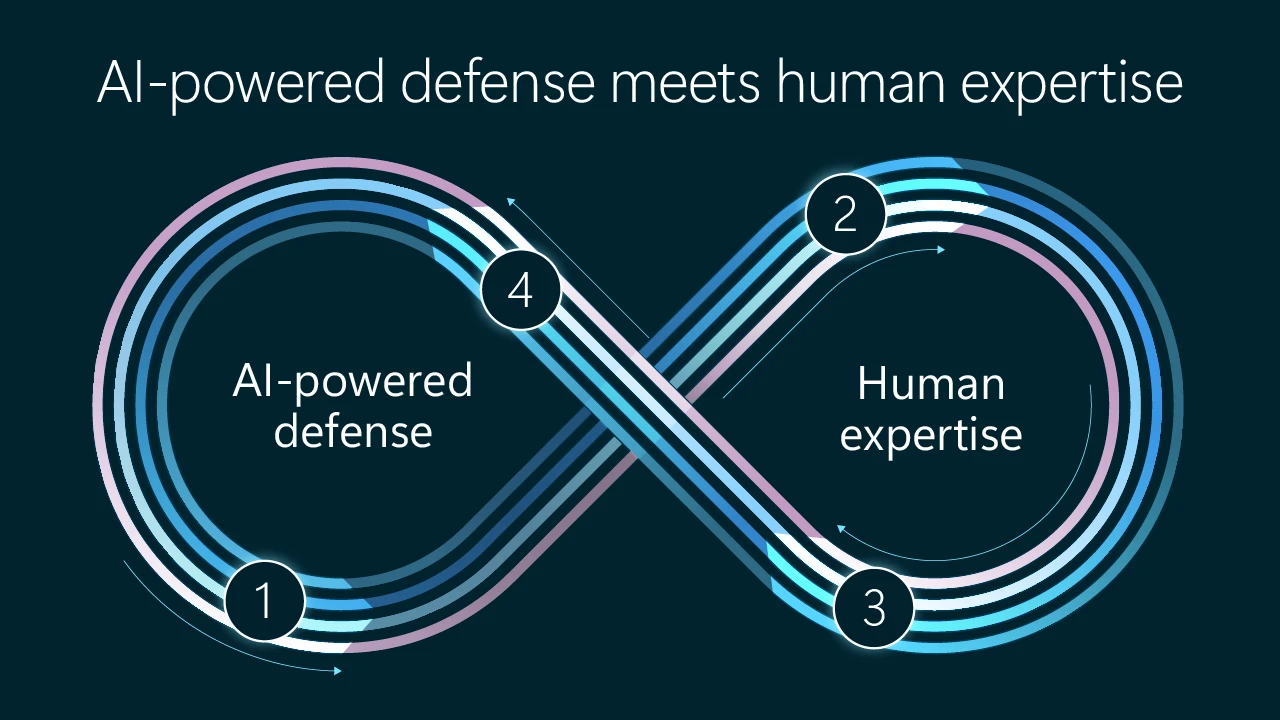
In the e‑book, we explore how autonomous defense is most effective when paired with human judgment and deep experience managing real incidents. Automated protection serves as the foundational security layer, blocking cyberthreats at machine speed, and reducing operational strain. When cyberattacks evolve or escalate, expert‑led hunting and managed detection and response bring global threat intelligence and real‑world insight to contain incidents and strengthen defenses. Human insights feed back into the platform, continuously improving automated protections and sharpening the organization’s overall security posture. In this video, we share a story of how fake profiles and fabricated identities can sometimes appear all too real.
Turn autonomous defense into resilient security
The e-book includes information about how organizations layer expertise at every stage of modern defense—combining autonomous protection with continuous human insight. Microsoft Security Experts helps in three key ways: with technical advisory to help modernize security operations, managed extended detection and response for around the clock defense against cyberthreats, and incident response and planning to build cyber resilience. The e-book further explains how this model emphasizes earlier threat discovery, reduced noise, and faster, more confident decision‑making as part of day‑to‑day security operations.
Sign up to download the e-book and read about how intelligence‑led incident response and direct access to security advisors can help organizations build long‑term resilience—not just recover from individual incidents. With expert guidance on readiness, response, and platform optimization, security teams can modernize operations, reduce integration overhead, and measurably improve outcomes. The result is a more resilient security program—one that resolves cyberthreats faster, lowers breach risk, consolidates cost, and enables teams to focus on solving meaningful security problems rather than chasing alerts.
Learn more about the Microsoft Defender Experts Suite
As security teams confront faster, more complex cyberattacks—and persistent gaps in skills and capacity—many are looking for practical ways to strengthen defenses without adding operational strain. The Microsoft Defender Experts Suite provides expert‑led security services to help organizations defend against advanced cyberthreats, improve resilience, and modernize security operations. If you’re exploring how to combine autonomous protection with continuous human expertise, read the full announcement for deeper context on what’s new and how these services work together.
Learn more
Learn more about Microsoft Security Experts and Microsoft Defender XDR.
To learn more about Microsoft Security solutions, visit our website. Bookmark the Security blog to keep up with our expert coverage on security matters. Also, follow us on LinkedIn (Microsoft Security) and X (@MSFTSecurity) for the latest news and updates on cybersecurity.
1Microsoft and Omdia, State of the SOC: Unify Now or Pay Later report, 2026.
The post Scaling security operations with Microsoft Defender autonomous defense and expert-led services appeared first on Microsoft Security Blog.